+1 (226) 337-9660

 English
Search

Vibration analysis is a technique used to detect incipient failures in rotating machinery and equipment. It allows companies to identify irregularities in the vibration behavior of motors, pumps, industrial gearboxes, compressors, and other assets before the issue becomes critical.
Through vibration analysis, it is possible to measure and interpret the mechanical oscillations of a machine during operation. These oscillations or vibrations are recorded by sensors and analyzed using specialized tools that help reveal imbalance, misalignment, mechanical looseness, bearing failure, and other issues.
In practice, vibration analysis works like a preventive medical exam for machines. Industrial equipment does not fail suddenly it gives warning signs. One of the most precise indicators that something is wrong is abnormal vibration.
This technique is widely used in:
It is especially indispensable in industrial environments where equipment reliability is directly linked to productivity, safety, and profitability.
Mechanical failures are costly not only financially. They disrupt production schedules, reduce asset lifespan, endanger operators, and cause unexpected operational shutdowns.
By using vibration analysis strategically, companies can:
Vibration is a natural phenomenon in any moving machine. For that reason, it becomes a rich source of information about equipment health.
Vibration is the oscillatory movement of an object around its equilibrium position. In industrial applications, virtually every rotating machine motors, pumps, compressors, and speed reducersexhibits some level of vibration during normal operation.
This vibrational pattern, known as a vibration signature, is essentially the machine’s unique identity. When that signature changes, especially in frequency or intensity, it indicates that something is wrong.
Mechanical vibrations can result from various conditions affecting machine components, such as:
Even new and well-adjusted machines cannot eliminate vibration entirely. Manufacturing tolerances and inherent oscillating forces naturally generate some vibration. What matters is that vibration remains within acceptable limits.
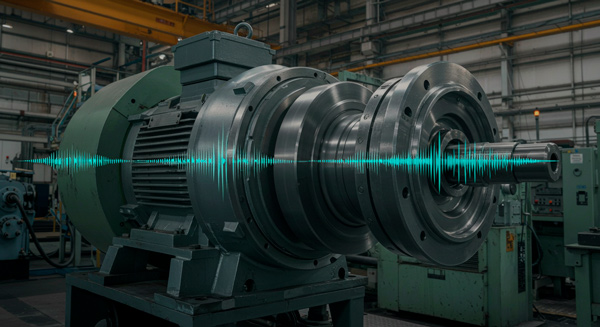
Excessive vibration can cause premature wear, unexpected failures, higher costs, efficiency loss, and safety risks. Monitoring and controlling vibration is therefore essential.
Three key parameters form the foundation of vibration analysis: frequency, amplitude, and phase.
Frequency indicates how many times vibration repeats per second and is measured in Hertz (Hz).
Each type of failure typically generates vibration at a specific frequency. For example:
Amplitude represents the magnitude of vibration and may be measured as:
Higher amplitude indicates greater energy and higher risk to equipment integrity.
Phase represents the time difference between two vibration signals at the same frequency but measured at different machine locations. Phase measurement is highly useful for comparative diagnostics and identifying how vibration propagates through structures.
Vibration analysis is based on measurable data that reveals the behavior of internal components and helps anticipate failures.
How is vibration analysis performed in practice?
The process begins with installing vibration sensors, typically accelerometers, at strategic points such as bearing housings or industrial gearbox casings.
Sensors capture mechanical vibration and convert it into electrical signals. These signals are transmitted to a data collector or specialized software, which interprets the information based on frequency, amplitude, and phase. Data can be visualized as time waveforms or frequency spectra, facilitating fault pattern identification.
Many modern platforms incorporate artificial intelligence capable of recognizing abnormal vibration signatures and suggesting diagnostic insights based on technical databases.
Finally, a specialist analyzes the results, correlates signals with root causes, and issues a preventive diagnosis before the issue becomes critical.
At Zanini Renk, vibration analysis is performed using advanced technology. Through the Field Assist 4.0 system, we implement a modern predictive monitoring model for industrial assets, delivering faster and more precise diagnostics.
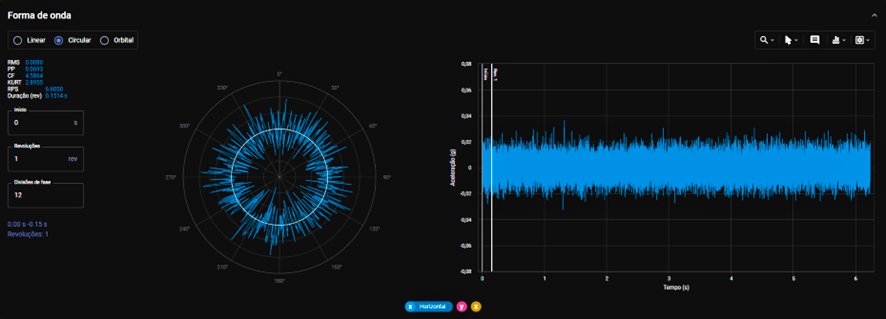
This system uses wireless industrial sensors that capture in real time:
Data is collected directly from critical machine points and transmitted to intelligent software. Customized alarms can be configured according to equipment characteristics, making it easier to detect deviations from ideal operating standards.
This level of precision and connectivity allows Zanini Renk to anticipate failures with greater reliability and deliver tailored solutions.
Learn more about Field Assist 4.0.
The key component is the vibration sensor, typically a piezoelectric accelerometer. In larger or critical machines, such as turbines and industrial gear reducers, additional devices may include:
Used for periodic inspections, these devices:
Ideal for offline monitoring.
Sensors remain permanently installed and transmit vibration data in real time via cloud systems.
This enables:
This is the model adopted by Zanini Renk with Field Assist 4.0.
Software tools transform raw vibration data into actionable insights by:
Depending on the application, the following may also be used:
Vibration analysis can identify:
Implementing vibration analysis provides:
Implementation begins with identifying critical assets, defining monitoring strategy (periodic or continuous), and selecting a qualified technical partner.
Field Assist 4.0: An intelligent monitoring system with wireless industrial sensors measuring vibration velocity, acceleration, frequency spectrum, and temperature in real time.
Specialized analysis for turbines and critical equipment: Our engineering teams interpret vibration data and identify root causes using advanced finite element software.
Customized action plan: Technical diagnosis with practical recommendations, intervention scheduling, and long-term asset reliability strategies.
Adopt a data-driven predictive maintenance culture with Zanini Renk and achieve fewer emergencies, greater reliability, and a safer, more competitive industrial operation. Contact our specialists!