+1 (226) 337-9660

 English
Search

Industrial lubricants are essential for ensuring performance, reliability, and durability in industrial environments. Proper industrial lubrication supports machinery efficiency, protects critical components, and extends service life under demanding operating conditions.
Industrial lubrication consists of applying a lubricating substance between moving surfaces to reduce friction and wear. By forming a protective film, lubricants enable smooth mechanical movement, minimize heat generation, and reduce the risk of premature equipment failure.
The primary objective of industrial lubrication is to protect assets and extend their service life. This is achieved by significantly reducing friction and, consequently, wear between moving machine components.
Proper lubrication also helps to:
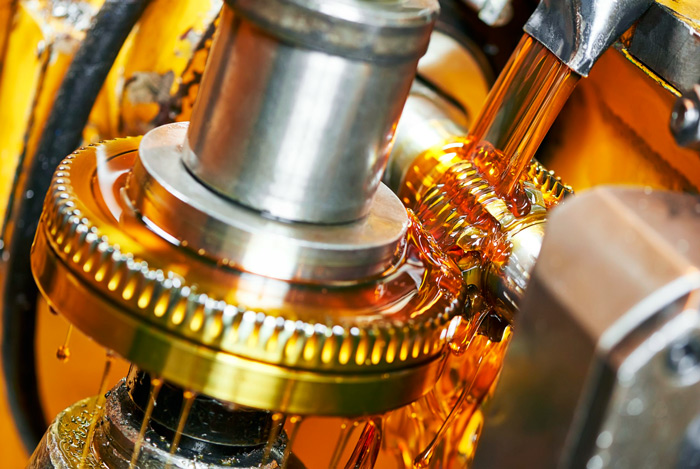
In industrial gear drives and rotating equipment, lubrication performance is governed by core physical principles that define how friction behaves between interacting surfaces:
The three main types of industrial lubricants are oils, aerosols, and greases. Each is suited to specific operating conditions. Oils are typically used in high-speed applications, aerosols are ideal for precise and targeted lubrication, and greases are preferred where liquid oil would leak or be displaced.
Formulated with a base oil and performance additives, lubricating oils are widely used in applications involving high speeds and significant loads. Their relatively low viscosity helps reduce friction losses and limit temperature rise in machine components.
Mineral oils are derived directly from crude oil refining, making them the most economical lubricant option. However, this cost advantage comes with limitations, such as greater viscosity variation with temperature changes and the potential presence of impurities that may lead to deposits.
Due to these characteristics, mineral oils generally require more frequent replacement compared to synthetic and semi-synthetic alternatives.
Synthetic oils are produced through advanced chemical processes that modify the molecular structure of petroleum or other raw materials. They offer superior properties, including more stable viscosity across a wide temperature range and greater resistance to chemical degradation.
Although they have a higher initial cost, synthetic oils provide enhanced performance, longer service intervals, and improved protection of machine components.
Semi-synthetic oils combine mineral and synthetic base stocks to deliver balanced performance characteristics. This blend offers improved thermal stability and oxidation resistance compared to mineral oils, while remaining more cost-effective than fully synthetic products.
They are well suited for applications that require better performance than mineral oils can provide, but where the cost of fully synthetic oils is not justified.
Aerosol lubricants are formulated to be applied as fine sprays, allowing uniform and precise coverage, even in hard-to-reach areas.
They are ideal for targeted applications and routine maintenance tasks. Their ease of use and quick application make them a practical solution for a wide range of industrial maintenance needs.
Greases are semi-solid lubricants with properties that make them suitable for specific operating conditions where liquid oils may not perform effectively.
They are especially valued in applications requiring lubricant retention, situations where oil could leak or be forced out due to gravity or centrifugal forces, such as:
Selecting the appropriate lubricant requires a careful evaluation of the equipment and its operating environment. Key factors include machine type, operating conditions, chemical compatibility, and viscosity requirements.

Modern industrial lubrication systems incorporate automation and monitoring technologies to improve reliability and reduce maintenance interventions.
Automatic lubrication systems deliver controlled lubricant quantities at programmed intervals, ensuring consistent machinery lubrication without manual intervention.
Centralized lubrication systems distribute lubricant from a single source to multiple points, improving operational efficiency and minimizing downtime.
Advanced techniques that use sensors and laboratory analysis to monitor the condition of the lubricant and machine components in real time, enabling predictive maintenance based on the actual operating condition of the equipment.
Zanini Renk customers have access to this service through Field Assist 4.0, a system that provides detailed lubricant oil analysis, including particle count, pressure, temperature, relative humidity, metallic particle concentration, and overall oil quality.