+1 (226) 337-9660

 English
Search

A steam turbine is a rotating thermal machine that converts the heat energy of water vapor into mechanical energy. This mechanical energy is typically used to drive an electrical generator or other types of industrial machinery.
Due to their high efficiency, steam turbines completely replaced the old piston-based steam engines. Today, these turbines are used in power plants around the world and play a major role in global electricity generation.
The primary function of a steam turbine is to convert the thermal energy of steam into rotational mechanical energy. In other words, the turbine acts as a key link in the process of transforming heat into usable energy.
This energy can be used to power a wide range of industrial equipment, such as compressors, pumps, and sugar mill drives.
Steam turbines are extremely versatile and are applied in various industrial sectors and energy generation systems. They are used wherever there is an abundant heat source that can be converted into mechanical work.
Some common applications include:
A steam turbine operates on a relatively straightforward principle: steam, usually produced in boilers through fuel combustion or solar heating, is directed under high pressure toward a series of blades mounted around a rotor.
When the steam collides with these blades, it transfers its thermal and pressure energy to the rotor, causing it to rotate. This rotational motion is mechanical energy that can either be used directly or coupled to a generator to produce electricity.
The greater the pressure difference between the steam inlet and outlet, the higher the efficiency.
The conversion of steam into mechanical energy occurs in two main stages: first, thermal energy is converted into kinetic energy through nozzles (also known as injectors). These nozzles narrow the passage through which steam flows, accelerating it and forming a high-speed jet.
Next, this jet strikes the blades mounted on the turbine shaft, causing the entire assembly to rotate under the force exerted by the steam.
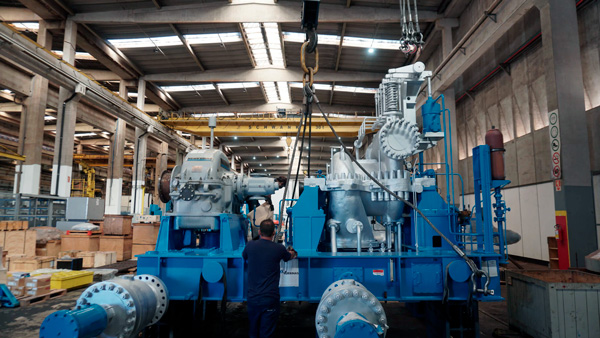
A steam turbine is a complex system composed of multiple components working together to convert thermal energy into mechanical motion.
The rotor is the heart of the turbine. It is the central shaft that rotates when driven by steam. Mounted on it are the moving blades that capture the steam's energy and convert it into rotational motion.
This shaft transmits mechanical energy to drive an electrical generator or other equipment.
Blades (also called vanes or buckets) are aerodynamic elements attached to both the rotor and the casing. They are designed to extract maximum energy from the moving steam.
Moving blades are directly driven by steam, while stationary blades (or guide vanes) help direct the steam flow to subsequent turbine stages, particularly in multi-stage turbines.
The casing is the enclosure that surrounds the entire internal turbine structure. It confines the high-pressure steam and ensures that it follows the correct path through the blades and nozzles. It also serves a protective function, preventing high internal temperatures and pressures from affecting the external environment.
Before reaching the blades, steam passes through nozzles, which are narrow channels that accelerate the steam flow by converting pressure energy into kinetic energy. This stage is essential to ensure the steam reaches the blades with enough velocity to generate motion.
Different nozzle designs exist depending on the turbine stage and application, including:
To prevent leakage along the shaft and preserve steam pressure, the turbine includes a complex sealing system.
Steam labyrinth seals are commonly used to minimize leakage between the rotating and stationary parts (rotor and casing). Other sealing systems are also employed to ensure tight sealing not only for steam but also for areas containing lubricating oil.
Steam flow is controlled by a set of valves that regulate the amount of steam entering the turbine. Control systems monitor rotor speed and adjust steam flow according to load demand. Safety systems automatically interrupt steam supply if excessive rotational speed is detected, preventing equipment damage.
Bearings and journal bearings support the rotor, allowing it to rotate with minimal friction while absorbing radial and axial loads depending on the turbine design. They are engineered to withstand high rotational speeds and significant loads generated during turbine operation.
After passing through the turbine, steam still contains usable energy. In many systems it is sent to a condenser, where it is cooled and returned to liquid form, completing the cycle. This process is part of the Rankine Cycle, which defines the operation of steam turbines in closed systems.
This is one of the most important distinctions when discussing steam turbine types.
Some turbines combine both principles, creating mixed turbines that optimize performance across different operating conditions.
Depending on required power output and pressure drop, turbines may have one or multiple stages.
In multi-stage turbines, steam passes through successive expansions and blade sets, extracting maximum energy. These stages may be designed according to:
The way steam is handled after leaving the turbine also defines different turbine types.
Steam turbines have been used for over a century and remain one of the most efficient and reliable technologies for energy generation.
One of the greatest advantages of steam turbines is their efficiency in energy conversion. In well-designed systems, thermal energy utilization is nearly complete. This occurs because turbines operate under high pressures and temperatures, maximizing the use of available heat. As a result, fuel consumption is reduced and overall energy system performance improves.
Steam turbines can operate using many heat sources, including:
This fuel flexibility allows them to be used in many industrial contexts. They are also highly scalable, meaning they can be designed for small installations or large power plants.
Steam turbines have long operational lifespans. Many operate continuously for decades with only scheduled maintenance. Because they have fewer moving parts than reciprocating piston engines, they typically experience lower wear rates and fewer mechanical failures. This makes them ideal for industrial processes and regions that require stable and continuous power supply.
Steam turbines can operate using renewable energy sources or waste heat, contributing to reduced greenhouse gas emissions. In cogeneration systems, residual steam can be reused for heating or industrial processes, maximizing energy utilization and reducing waste.
If your industrial plant operates steam turbines or is seeking solutions to modernize and improve their performance, Zanini Renk is the ideal partner. With excellence in applied engineering, we provide comprehensive solutions for the power generation sector.
Our key advantage is our ability to service turbines from any manufacturer with agility, quality, and competitive cost.
Our services include:
Extending the life of steam turbines has never been more efficient or accessible. Contact a specialist and request a technical audit.