+1 (226) 337-9660

 English
Search

Industrial gearboxes play a central role in major industrial processes. They are responsible for converting motor torque into useful, controlled, and continuous motion. Because of this critical function, an industrial gearbox must operate in perfect harmony, with gears, bearings, and lubrication performing at optimal levels.
When this balance is disrupted, failures occur. Contrary to common belief, most industrial gearbox failures are not caused by major accidents, but by small deviations that accumulate over time.
Below are the main causes of industrial gearbox failures and how to prevent them.
Among all failure causes, improper lubrication remains the most common. Gearbox oil creates a protective film that separates metal surfaces under high loads and ensures smooth operation.
When the gear oil has incorrect oil viscosity, is contaminated, or is used in insufficient volume, the lubricating film breaks down. This causes direct contact between gear teeth, leading to friction, noise, and accelerated wear that can ultimately result in catastrophic gearbox failure.
Prevention starts with following the manufacturer’s specifications. However, it goes further: the lubricant must be replaced at the correct intervals, properly filtered, and monitored for temperature and metal particle contamination.
In critical applications, contamination and temperature sensors are essential tools, allowing early detection of issues before irreversible damage occurs.
An oversized industrial gearbox represents unnecessary cost, while an undersized one is a failure waiting to happen. When applied torque exceeds the rated capacity, excessive stress is transferred to gears, shafts, and bearings.
This type of failure is often observed when more powerful motors are installed without recalculating the service factor or verifying the gearbox’s torque capacity and load rating.
Avoiding overload requires proper engineering. The design must consider nominal power, application severity, load type, and duty cycle. Variable frequency drives and soft-start systems help reduce torque peaks, but correct sizing from the start is the most effective solution.
Even minimal shaft misalignment is enough to disrupt gear tooth contact patterns. The result is uneven power transmission, concentrated loads, excessive vibrations, and noise. Over time, this leads to irregular gear wear and reduced efficiency.
During installation, shaft alignment must be performed using precision tools such as laser alignment systems. The mounting base must be level and free from mechanical stress. After initial operating hours, retightening fasteners and rechecking alignment are critical steps.
The operating environment has a direct impact on industrial gearbox durability. Dust, moisture, and metallic particles can enter through breathers or worn seals. Once inside, contamination degrades the lubricant, accelerates component wear, and may cause internal corrosion.
A well-designed sealing system is the first line of defense. Dual-lip seals, clean breathers, and proper filtration are essential. In aggressive environments, gear reducers with filtered or pressurized ventilation are recommended. Continuous oil monitoring is also important, as changes in color and laboratory analysis reveal valuable insights into internal conditions.
Bearings act as the joints of an industrial gearbox, supporting radial loads and axial loads. When bearing failure occurs, the entire system is compromised. Contaminated grease, improper installation, or incorrect preload are common causes. Insufficient bearing lubrication drastically shortens service life.
Bearings should be installed in clean environments using proper tools. Correct bearing specification (such as C3 or C4 clearance), according to application and operating temperature, must be respected. Monitoring noise and temperature allows early detection of incipient failures.
Vibrations are inherent to industrial equipment, but they become a concern when excessive or abnormal. Causes may include misalignment, mechanical looseness, imbalance, or structural resonance.
The effects are consistent: shaft fatigue, cracks in gears, and loosening of fasteners.
Periodic vibration analysis helps identify irregularities at an early stage. In critical production lines, permanent sensors enable continuous vibration monitoring, significantly reducing the risk of unexpected failures.
Heat is a natural byproduct of mechanical operation, but overheating beyond design limits becomes destructive. Excessive heat degrades lubricants and reduces material strength, compromising gearbox performance.
Monitoring operating temperature through sensors or visual inspection for leaks, noise, or lubricant odor changes is essential. Thermal management solutions such as fans and heat exchangers improve heat dissipation, especially in continuous-duty or high-load applications.
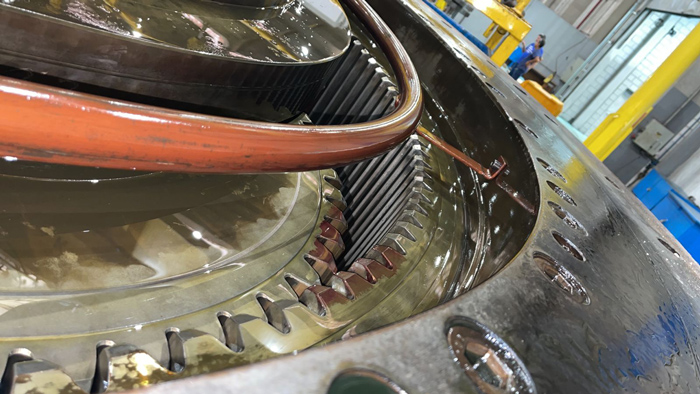
Surface fatigue, known as pitting, is one of the most common gear-related failures. It occurs when contact stress exceeds material limits, forming small craters on the gear surface.
While pitting is inevitable over very long service life, it can be controlled through proper heat treatment, correct lubrication, and regular analysis of gear mesh and contact patterns. High-quality gears with uniform carburizing and corrected helix geometry distribute loads more evenly and extend service life over millions of cycles.
Cracks in housings or covers indicate structural issues, often related to overload, excessive vibration, or improper mounting. Beyond compromising structural integrity, these failures affect internal alignment and trigger a cascade of secondary issues.
Designs validated through finite element analysis (FEA) and high-stiffness materials ensure robustness. Proper tightening torque during installation prevents deformation and premature failure.
The reliability of an industrial gearbox is not determined by design alone. It results from the combination of engineering excellence, correct installation, and continuous maintenance. From lubrication to sealing, every detail directly impacts performance and service life.
RSG Zanini Renk takes reliability seriously. Our industrial gearboxes undergo rigorous inspections, predictive analyses, and quality control processes aligned with international standards. With specialized technical support, we transform maintenance into a strategic advantage reducing unplanned downtime, increasing availability, and ensuring uninterrupted operation.
The best maintenance strategy is the one that anticipates problems before they occur.
Contact the specialists at RSG Zanini Renk and discover how our reliability engineering extends the service life of industrial gearboxes and speed reducers.