What is a vertical lathe?
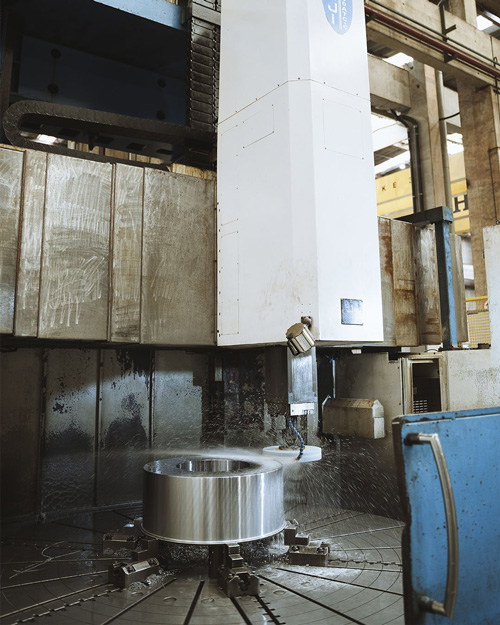
A vertical lathe, also known as a vertical turning lathe (VTL), is a machine designed to machine parts with large diameters or heights. It is widely used in industries such as steelmaking, boilermaking, and automotive equipment manufacturing, and it stands out for its ability to handle bulky, heavy components with high precision and efficiency.
What is a vertical lathe used for?
A vertical lathe has a vertically oriented spindle, and the workpiece sits on a rotary table that turns in a horizontal plane. The main advantages of using a vertical lathe are:
- Handling heavy parts: the vertical orientation makes it easier to load and unload large, heavy parts.
- Space optimization: vertical lathes take up less floor space than horizontal ones.
- Precision: CNC machining on vertical lathes delivers high precision, making it possible to manufacture critical components with quality.
Differences between vertical and horizontal lathes
The main difference between vertical and horizontal lathes lies in the orientation of the spindle and the position of the workpiece. On horizontal lathes, the spindle holds the part horizontally, which is ideal for machining long, slender parts. Vertical lathes, with their vertical spindle, make it easier to machine large, heavy parts.
What types of lathes are there?
There are several types of lathes, each with features suited to different industrial needs. Besides horizontal and vertical lathes, the main ones are:
- Turret lathe: makes several parts at once, with cutting tools set up for successive operations. Ideal for large-scale production.
- Automatic lathe: performs programmed operations with high precision and repeatability. Used in high-quality, large-scale production.
- Copy lathe: replicates parts based on a specific template. Ideal for producing complex parts in large volumes.
- Faceplate lathe: used for large-diameter industrial parts with specific dimensions, such as locomotive wheel rims.
- CNC (computer numerical control) lathe: computer-controlled and capable of performing multiple operations with high precision. Suited to large-scale production of complex parts.
- Conventional lathe: manually operated. Ideal for small batches and maintenance work.
- Multi-spindle automatic lathe: has several spindles for simultaneous operations. It offers high productivity but requires complex setup, and is used for large production batches.
- Swiss-type lathe: delivers high precision with a sliding headstock. Ideal for watch parts and components with tight tolerances.
What is turning?
Turning is a machining process in which a cutting tool removes material from a rotating workpiece. The part is clamped in a lathe and spins around an axis, while the tool moves in a straight line to give it shape.
Why turning matters in industry
Turning is the machining process used to manufacture cylindrical and conical parts. The principle of spinning a piece around its axis dates back to antiquity, when it was used to make pottery.
In modern industry, turning makes it possible to produce components with high precision and an excellent surface finish, both essential to the performance and durability of machines and equipment. The process is used to manufacture parts for many industrial applications, such as shafts, pulleys, bearings, and more.
Basic turning movements
Turning involves three main movements between the workpiece and the cutting tool:
- Cutting: the main movement, which actually removes the material.
- Feed: the movement of the tool along the surface of the part, which ensures a continuous, uniform cut.
- Depth of cut: the movement that pushes the tool into the part, defining how deep it cuts.
Main components of an industrial lathe
Most lathes are made up of the following components.
Machine body
The main structure that supports all the other components. It consists of:
- Bed: a rigid, flat surface along which the main carriage slides lengthwise. It gives stability and precision to the machining process.
- Headstock: the part of the machine that houses the main spindle, which rotates the workpiece.
- Tailstock: a component that moves along the bed and can be locked in different positions. It holds the tailstock center that keeps the workpiece steady.
- Speed gearboxes: contain gears that allow the rotation and feed speeds to be changed.
Spindle drive system
Transmits rotary motion to the main spindle. It consists of:
- Motor: the power source that drives the lathe.
- Pulley: transmits power from the motor to the main spindle.
- Gears: used to adjust rotation speeds.
- Gear reducers: reduce the motor speed to suitable operating levels.
Tool and workpiece movement systems
Allow controlled movement of the cutting tool and the workpiece. They consist of:
- Gears: transmit motion and adjust speeds.
- Feed gearbox: changes the speed and direction of movement.
- Reversing mechanism: allows the direction of rotation to be changed.
- Lead screw and feed rod: threaded shafts that move the cutting tool lengthwise and crosswise.
Tool and workpiece holding systems
Keep the cutting tool and the workpiece firmly held during machining. They include:
- Turret: the structure on which the cutting tools are mounted.
- Tool post: holds the cutting tools.
- Cross slide and main carriage: move the cutting tool crosswise and lengthwise.
- Chucks: clamp the workpiece to the headstock.
- Tailstock: helps keep the workpiece steady during machining.
Speed and movement controls
Allow the operator to control movements and speeds. They consist of:
- Handwheels: used for fine manual adjustments.
- Levers: used for quick gear and speed changes.
Types of vertical lathes: manual and CNC
A manual lathe, or conventional lathe, requires the operator to perform every action by hand. This type is versatile and widely used in woodworking, metalworking, and smaller-scale projects.
A CNC lathe (computer numerical control) automates the machining process using computer programs. Ideal for complex, repetitive production, CNC delivers meticulous precision and reduces human error, ensuring highly consistent quality in the machined parts.
High-precision vertical turning at Zanini Renk
At Zanini Renk, we combine more than 50 years of tradition with technological advances to deliver high-precision machining on vertical lathes. With a fleet of five vertical lathes, four of them CNC, we can machine anything from small bushings to large gears and critical components such as planet carriers and support plates.
Our machines, sourced from Europe, Asia, and Brazil, operate in controlled environments to ensure precision and quality. This commitment to excellence allows us to deliver reliable, high-precision solutions.
Contact our team to learn about the right solutions for the most demanding industrial environments.
 +1 (226) 337-9660

 English