+1 (226) 337-9660

 English
Search

Mining is, probably, the most demanding industrial environment a gearbox will ever face, as it involves:
Any failure in a critical piece of equipment along the production chain (a belt conveyor, a mill, a stacker-reclaimer) can bring the entire operation to a halt, causing significant losses.
The problem is that most industrial gearboxes on the market were designed for general-purpose applications. They perform well under controlled conditions, with predictable load cycles and regular scheduled maintenance. When placed inside a mining plant running continuous duty, these units start operating outside the conditions they were rated for, and the result is premature wear, degraded lubricant, unplanned downtime, and costly corrective maintenance.
The RSG "For Mining" from Zanini Renk was developed to solve exactly these problems. It is an architecture purpose-built for the severe conditions of mining, with active thermal management, an oil filtration and circulation system, and real-time monitoring integrated directly into the drive unit.
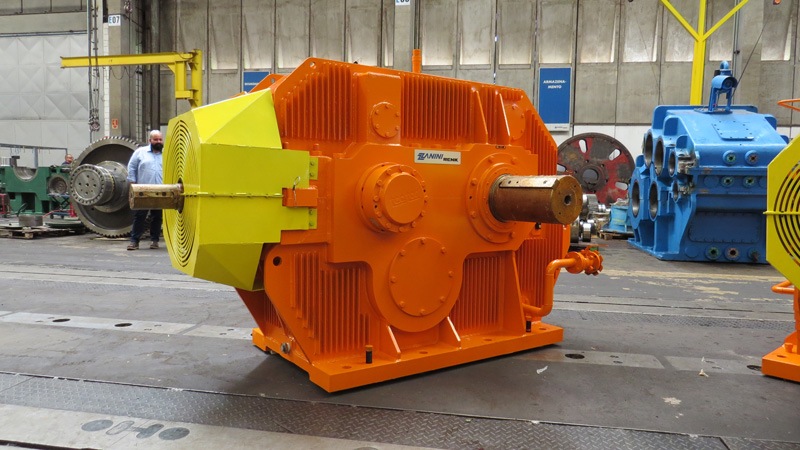
Three combined factors make mining a particularly destructive environment for industrial gearboxes:
Gearboxes running continuous duty generate heat through mechanical energy dissipation at the gear mesh and in the bearings. In 24/7 operations, that heat has no time to dissipate between cycles. The lubricating oil absorbs part of this thermal energy and, when temperature exceeds its stability limits, begins to degrade: viscosity drops, the protective film between gear teeth thins out, and wear accelerates exponentially.
Mining means heavy dust. With particles of ore, quartz, and silica suspended in the air, conventional sealing systems cannot prevent them from reaching the oil. Once inside the lubricant, these abrasive particles act as an internal wear agent, damaging bearing races and gear flanks with every operating cycle.
Jaw, cone, and gyratory crushers generate torque spikes every time a rock of variable size enters the crushing chamber. Vibrating screens subject the gearbox to continuous vibration cycles. Ball mills have heavy starts and load variations depending on the fill level. These shocks, repeated millions of times over the life of the equipment, fatigue the internal components of units that were sized for uniform loads.
Maintenance accounts for 30% to 50% of operational budgets in mining, according to industry data. Undersized or misapplied gearboxes contribute directly to that figure.
For general-purpose industrial gearboxes, thermal management is typically passive, relying on natural air convection over the housing to dissipate heat. In open environments with controlled ambient temperature, that is enough. In a mining plant where the equipment may run in enclosed buildings, under direct sun in tropical regions, or near other heat-generating machinery, passive cooling cannot maintain stable oil temperature.
Basic lubrication systems (splash lubrication without forced circulation or filtration) were not designed for environments with high contamination loads either. Oil recirculates inside the sump, but contaminants that enter do not leave. Without continuous filtration, contamination builds until it reaches levels that accelerate wear on internal components.
Thermal oil degradation deserves particular attention because it is the primary driver of accelerated wear in bearings and gears. Above 80°C (176°F), most conventional mineral oils begin losing viscosity significantly. Above 100°C (212°F), oxidation accelerates and lubricant service life drops sharply.
The RSG is Zanini Renk's line of Renk Standard Gearboxes (Renk Standard Gearboxes), developed with a modular design and high configurability for different industrial applications. The "For Mining" variant is a specific build within this line, with a component architecture designed for mining conditions.
The reinforced housing absorbs shock loads and vibration without transmitting distortion into the internal components. Gears are manufactured from case-hardened and precision-ground alloy steels, including the 18CrNiMo7-6 grade, which combines high surface fatigue strength with good core toughness. This material withstands load cycles that would fracture standard carbon steel gears.
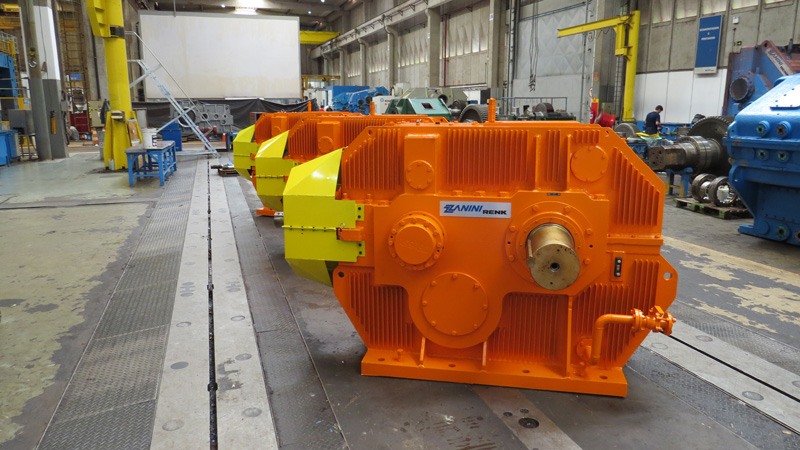
What separates the RSG For Mining from standard gearboxes is the integration of systems that work together to keep the drive operating within safe parameters, even in continuous duty and harsh environments.
The architecture includes:
Each of these systems addresses one of the three core problems of severe-duty operation: the heat exchanger handles temperature, the filtration handles contamination, and the monitoring turns data into maintenance decisions. Together, they change the degradation profile of the gearbox across its entire service life.
The Forced Cooling system of the RSG For Mining operates as an air-to-oil heat exchanger coupled to the gearbox's lubrication circuit. Oil heated at the gear mesh is continuously drawn from the housing, cooled in the heat exchanger, and re-injected into the system already within the safe temperature range. The dual forced-air ventilation complements this process, actively removing heat from the housing.
By maintaining oil temperature within a stable range (regardless of ambient temperature or applied load), the system eliminates hot spots — localized overheating zones that commonly form at output bearings in standard gearboxes running under full load.
Controlled temperature means, directly, longer lubricant service life. Oil that consistently operates below 70°C (158°F) degrades very differently from oil oscillating between 85°C and 110°C as load varies. In the first case, oil change intervals are longer and lubricant film quality remains stable. In the second, the oil oxidizes faster, loses viscosity, and stops protecting bearing surfaces and gear flanks adequately.
Particles harder than the component steel (silica and metallic oxides present in mining Dust) act as three-body abrasives at the interface between rolling elements and bearing races. The result is accelerated wear that generates more metal particles, which further contaminate the oil, in a self-reinforcing cycle.
The RSG For Mining's continuous filtration system breaks this cycle. Oil circulates permanently through a filter assembly that captures particles before they complete the circuit and return to the contact points of internal components. The ISO 4406 standard — which classifies cleanliness in three digits representing particles larger than 4 µm, 6 µm, and 14 µm — can be actively controlled in this system, which is simply not achievable with splash lubrication and no forced circulation.
The intelligent lubrication control integrates sensors that monitor, in real time:
These sensors work alongside local visual indicators and electronic outputs that can be integrated into the plant's supervisory control system. The maintenance manager does not have to wait for the next scheduled walk-around inspection to know whether the gearbox is within parameters, the unit reports its own condition continuously.
The concept Zanini Renk applies to the RSG For Mining is the Smart Gearbox, a drive that, beyond fulfilling its role as a mechanical power transmission component, is also a monitored asset capable of reporting its own operational condition in real time.
With integrated monitoring, the intervention plan is driven by the actual state of the equipment. This approach is compatible with predictive maintenance strategies and with integration into supervisory control systems (SCADA, DCS, or CMMS asset management platforms).
Zanini Renk's Field Assist 4.0, wireless vibration and oil analysis sensors with an online dashboard, can be applied alongside the RSG For Mining to add further monitoring depth, including spectral vibration analysis, incipient fault pattern identification, and long-term trending.
For a mining operation that requires maximum equipment availability, the combination of a properly engineered gearbox and continuous monitoring is what makes it possible to plan scheduled maintenance windows instead of reacting to failures. Unplanned downtime in mining costs:
The main applications of the RSG For Mining in mining cover equipment with very different load profiles:
The impact on total cost of ownership (TCO)
TCO, Total Cost of Ownership, is the accumulated cost of an asset across its entire service life, not just the purchase price. It includes preventive and corrective maintenance, component replacements (bearings, seals, oil), labor for interventions, shutdown logistics costs, and the production losses associated with time the equipment spent out of service.
For gearboxes in mining, the difference between a standard unit and one with the right architecture shows up clearly in TCO. The most measurable gains from the RSG For Mining are:
The TCO analysis justifies the investment in a more complete solution because the purchase price differential typically represents a small fraction of the costs avoided over five, ten, or fifteen years of operation.
Correctly specifying a gearbox for a mining application involves criteria that go well beyond rated torque. The plant engineer or maintenance manager responsible for the specification needs clarity on each of the following:
Zanini Renk provides engineering support throughout this specification process as part of ensuring the equipment delivers the expected performance and durability under the actual conditions of the plant.
Explore our RSG Standard Gearboxes and find the right drive for your mining operation with the RSG For Mining, engineered to keep running.