+1 (226) 337-9660

 English
Search

Behind the performance and durability of an industrial speed reducer, there is a science that often goes unnoticed: materials engineering.
Materials engineering is a branch of engineering dedicated to understanding how different materials behave, how they can be transformed, and how their properties can be improved to meet the demands of modern industry. This field studies metals, polymers, ceramics, and composites to develop solutions that are stronger, lighter, more durable, and more sustainable.
Every gear, shaft, and bearing must withstand millions of load cycles under high temperatures and extreme torque conditions. For this reason, the correct metallurgical selection is just as important as the mechanical design itself.
In the RSG Zanini Renk, materials engineering is treated as a strategic factor for reliability. Components are designed and manufactured using carefully selected alloys, subjected to controlled heat treatment processes, and validated through rigorous metallographic testing.
The result is a mechanical system engineered for maximum precision, strength, and long service life, even in severe industrial environments.
Industrial gear reducers operate under critical conditions: high torque, cyclic loads, and constant temperature variations. Under these conditions, the behavior of the material defines the boundary between reliability and premature failure.
Materials engineering applied to gear reducers plays an essential role in:
Even the best mechanical design can be compromised if the material does not perform under load. For this reason, metallurgical precision is a key pillar of reliability in the RSG Zanini Renk.
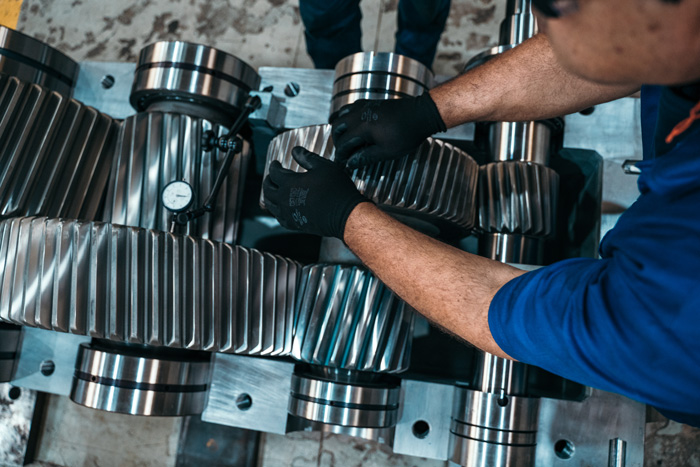
Material selection follows international standards such as DIN, ISO, and AGMA, ensuring compatibility with global requirements and superior performance.
These steels combine high mechanical and good toughness, and are used in shafts and structural components. They can withstand high torque levels and moderate impacts while maintaining dimensional integrity even after long hours of operation.
These are the most commonly used steels in high-performance gears. After carburizing and quenching, they develop an extremely hard surface (58-62 HRC) with a ductile and resistant core, ideal for repetitive contact loads.
The 18CrNiMo7-6 stands out for its superior metallurgical purity, high hardenability, and dimensional stability, resulting in gears that operate with lower noise and extended service life, even under large modules and heavy loads.
Used in precision components, such as shafts and gears that require wear resistance and minimal thermal distortion. The nitriding process creates a hardened surface layer without quenching, reducing internal stresses and distortions. This makes them ideal for high-precision gear reducers in continuous operation.
Used in housings and structural supports, ductile cast irons provide rigidity and vibration absorption. Stainless steel alloys and special materials are used in corrosive environments or high-temperature applications, expanding the versatility of RSG Zanini Renk speed reducers.
Heat treatment is the link between metallurgical design and the actual performance of the component. It is during this process that the steel acquires the properties that define its strength and durability.
At the RSG Zanini Renk, processes are certified and carried out in controlled atmosphere furnaces, ensuring uniformity and full traceability.
Main procedures include:
These treatments, combined with proper alloy selection, result in components that maintain stable performance over decades of operation.
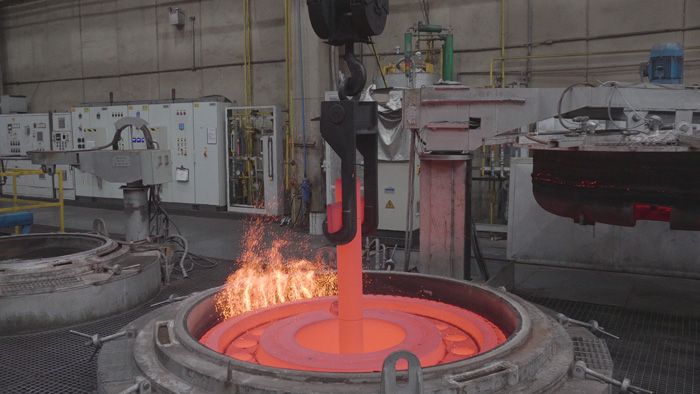
Metallurgical quality control is one of the most critical stages in manufacturing RSG Zanini Renk speed reducers. Each batch undergoes testing to ensure that both the material and the heat treatment meet design parameters.
Main tests include:
These controls ensure uniformity, reproducibility, and predictable performance, allowing gear reducers to operate efficiently and safely even under the most severe industrial conditions.
The metallurgical excellence of the RSG Zanini Renk also reflects its commitment to sustainability.
Heat treatment processes use controlled atmosphere furnaces and thermal energy recovery systems, reducing emissions and energy consumption. In addition, digital monitoring of metallurgical parameters and circular economy practices in the reuse of metallic waste are applied.
This approach combines high performance with environmental responsibility, key pillars of modern industry.
The longevity of an industrial speed reducer begins with the science behind its metallurgy.
The combination of high-performance alloys, precise heat treatment processes, and strict metallurgical control is what ensures the exceptional durability and reliability of Zanini Renk RSG speed reducers.
In other words, Zanini Renk does more than design gear reducers. We engineer reliability, metal by metal, gear by gear.
Contact the RSG Zanini Renk engineering team to discover customized solutions for various industrial sectors.