+1 (226) 337-9660

 English
Search

In the demanding environment of the sugar and ethanol industry, Zanini Serviços stands out in highly specialized areas such as heavy machining and heavy fabrication. Recently, we reached a new level of excellence with the successful completion of a challenging project for the Cevasa sugar mill: the recovery of an 8-meter diffuser shaft.
Component recovery is a strategic service in the industrial sector. Due to natural wear and exposure to severe conditions during continuous operation, components can develop failures that compromise equipment efficiency and safety. Through recovery, it is possible to restore components to their original functionality rather than discarding them, which is a more cost-effective solution than full replacement. This minimizes resource waste and extends equipment lifespan.
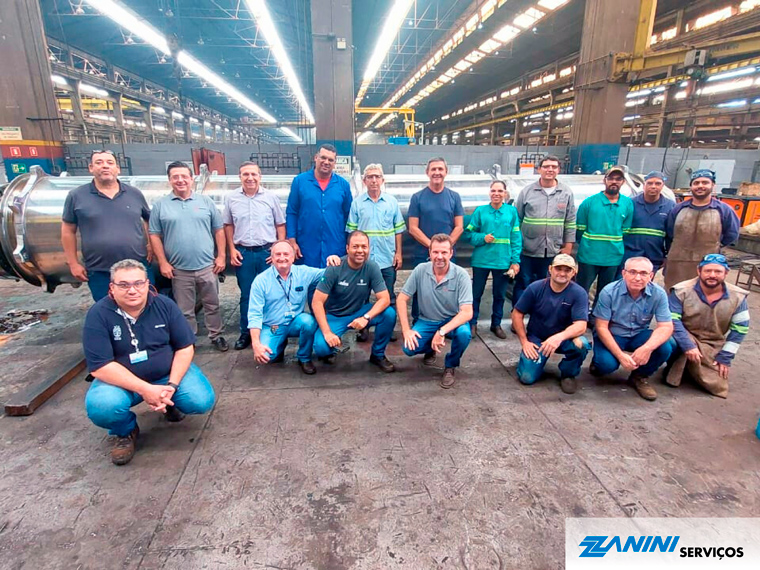
With a production capacity of 300 tons per month, this is a fundamental component in the sugar mill's diffuser extraction process. Juice extraction is one of the first and most important stages of sugar production, as it determines production volume and impacts final product quality.
In this article, we cover this important stage in sugar production, understanding the differences between extraction with sugar mills and diffusers, and the importance of the shaft.
The sugar and ethanol industry is one of the driving forces of Brazilian agribusiness, with a history dating back to the colonial period. As a pioneer in sugar and ethanol production, both derived from sugarcane, Brazil has established itself as a global leader in this market.
The sector not only plays a crucial role in the national agribusiness but also stands out as an example of added value within the economy. Contributing more than 18.5% to the country's energy mix, this sector goes beyond simple sugar and ethanol production, positioning itself as a pillar of innovation and sustainability.
Brazil stands out as the world leader in sugar production and trade, and faced a crucial decision during the 2022/2023 harvest: increasing sugar production at the expense of ethanol. This choice was influenced by two main factors.
First, global climate challenges reduced sugar supply, raising demand and prices on the international market. This made sugar production particularly profitable for Brazilian producers.
Second, changes in Brazilian fiscal policies reduced the competitiveness of ethanol compared to gasoline, discouraging its production.
These factors made sugar production the most advantageous option. For the 2024/2025 harvest, the trend is expected to continue, with expectations that sugar production will reach record levels, using more than 50% of the sugarcane for this purpose.
Sugar production can be divided into two main phases: juice preparation and the crystallization process. Here are the stages involved:
Sugar production in Brazil relies on two main techniques for extracting sucrose from sugarcane: the sugar mill and the diffuser. Both methods have the same objective but operate in distinct ways, with specific advantages and challenges.
The sugar mill works through the physical pressing of cane between heavy rollers or cylinders that crush the fibers, releasing the sugar-rich juice.
This process is repeated in several stages to maximize juice extraction. To further improve efficiency, water is added to the bagasse between milling stages to extract additional sucrose.
The remaining bagasse, now with lower sucrose content, is frequently used as fuel in the mill's boilers.
Sugar mills require considerable energy to operate, mainly due to the need to physically crush the cane between heavy rollers to extract the juice.
It is important to note that crushing can generate excessive heat, impacting juice quality and the performance of fermentation enzymes.
The diffuser uses a solvent extraction process, in which prepared sugarcane is subjected to repeated washing with water or diluted juice, in countercurrent flow, to extract the sucrose.
This method is based on the concentration difference between the solution inside the cane cells and the washing solution, facilitating the transfer of sucrose to the washing liquid.
This process, being less dependent on intense mechanical force and more based on mass transfer through concentration difference, results in lower mechanical energy consumption.
The diffuser is considered more efficient in terms of sucrose extraction and is less impactful on the cane fiber, which can be beneficial for the quality of bagasse used for energy generation.
The diffuser shaft acts as the heart of the diffusion system. It is responsible for transmitting the necessary motion for the diffuser to operate, ensuring the proper movement of sugarcane bagasse through the system.

The effectiveness of the diffuser shaft is vital for extraction efficiency at the sugar mill. Through its movement, the shaft ensures the uniform distribution of heat and water throughout the entire system, elements that are crucial for effective leaching.
This homogeneous distribution is what allows all the bagasse to be properly processed, resulting in more efficient juice extraction and maximizing sucrose production.
Any issue with the shaft, such as misalignment or mechanical failures, can cause problems that compromise the uniform distribution of heat and water, negatively affecting extraction efficiency and, consequently, plant productivity.
The efficiency and reliability of the diffuser shaft are crucial for continuous, failure-free operation of the diffusion process. These are essential elements for maintaining operational quality and plant profitability. Recognizing the vital importance of these components, Zanini Serviços stands out in the market for its exceptional capacity for recovering large industrial components.
With a recovery process that employs high-resistance materials and the most advanced technology, we ensure the restoration of the diffuser shaft's durability and performance, so it can withstand the extreme conditions and continuous operational loads it is subjected to.
This recovery service not only extends the shaft's lifespan but also contributes significantly to the continuity and efficiency of mill operations.
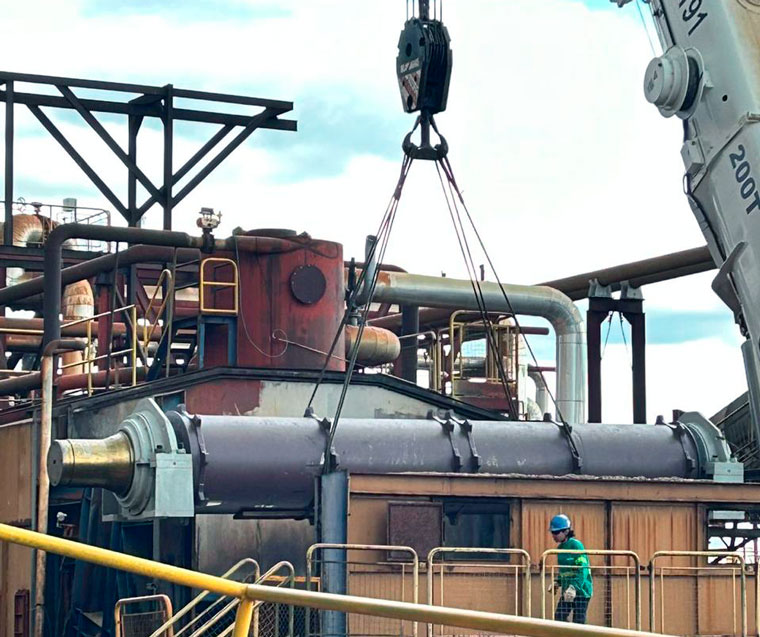
The production capacity of Zanini Serviços, at 300 tons per month, allows us to meet the most demanding needs not only in the sugar and ethanol sector but also in several other industries such as cement, mining, oil and gas, naval, among others. This reinforces our leadership and expertise in the recovery of large industrial components.
With Zanini Serviços, the Cevasa sugar mill found a supplier and a strategic partner dedicated to offering solutions that maximize operational efficiency and contribute to the sustainable success of the sector.