 +1 (226) 337-9660

 English
Search

Vibration is part of the daily routine of any sugar and ethanol mill, but it is also an important indicator of problems that can develop until they force a shutdown. Noticing that vibration has increased is only a small part of solving the problem. What really matters is understanding the reason behind the change: is it a bearing, a gear, or misalignment?
Finding that answer is exactly what online monitoring with Zanini Renk’s Field Assist 4.0 does inside the mills. Here is how this technology traced the source of a vibration problem and kept it from turning into something capable of impacting the operation.
The scenario: a high-speed gear reducer driven by a turbine at the first mill of the milling tandem in a sugar and ethanol plant.
The vibration analysis sensors installed on the bearing housing began to record a steady rise in the overall RMS (root mean square) velocity trend, a single value that summarizes the overall magnitude of vibration. When this line goes up and does not come back down, it signals a persistent change in the vibration behavior of the assembly, and that change needs to be investigated.
Our team opened the spectrum, which shows vibration broken down by frequency, and took measurements in all three directions: axial (along the shaft), vertical, and horizontal. Two readings stood out:
|
Measurement point |
Direction |
Frequency |
Vibration |
|
Input shaft |
Axial |
1x RPM (107.8 Hz) |
5.97 mm/s |
|
Output shaft |
Axial |
1x input shaft RPM |
6.45 mm/s |
What caught the team’s attention was that the energy was concentrated in the axial direction and locked at 1x RPM, which means one oscillation per shaft revolution.
High axial vibration at 1x RPM is a signature often associated with angular misalignment, and it can point the investigation toward the coupling.
Bearing and gear defects, on the other hand, usually produce characteristic components that differ from simple shaft rotation, often at higher frequencies, such as:
Also read: Top causes of industrial gearbox failures and how to prevent them
With the diagnosis pointing to the coupling, the inspection went straight to the right spot and confirmed what the spectrum had shown:
Lubrication-related problems are behind roughly 75% of gear coupling failures.
A coupling in good condition absorbs small misalignments between the turbine and the gear reducer within design limits, controlling the forces transmitted to the assembly. When it seizes because of hardened grease and wear, the restricted movement increases the cyclic axial forces transmitted to the shafts and bearings.
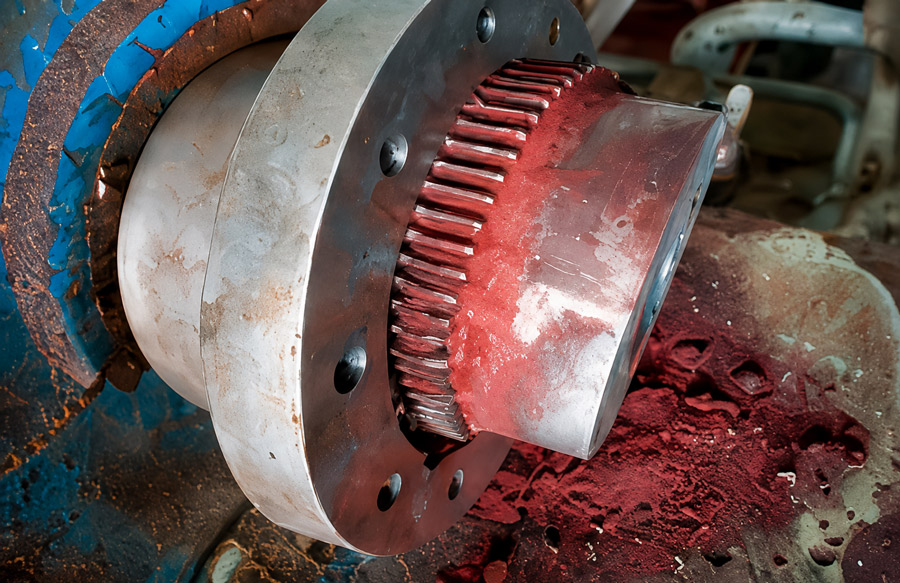
Early detection turned a condition that could have evolved into more severe damage and an unplanned shutdown into a scheduled maintenance stop. There was time to plan the intervention for a suitable window, avoiding the surprises and costs of an emergency.
Corrective maintenance usually costs more than planned maintenance once you account for the production stop, rushed repairs, and urgent parts purchases. Acting early is always the better option for the budget.
Sensor, analysis, and a skilled team: this combination is the foundation of Field Assist 4.0, Zanini Renk’s condition monitoring platform. The sensor collects the data, but it is the engineering behind it that turns data into the right decision. Without that interpretation, a number on the screen is just a number.
Is your plant ready to identify problems before they turn into shutdowns? Contact us to find out how online monitoring can transform your results.