+1 (226) 337-9660

 English
Search

Helical gears are fundamental components in many machines and mechanical systems, standing out for their ability to transmit motion and power with efficiency and precision.
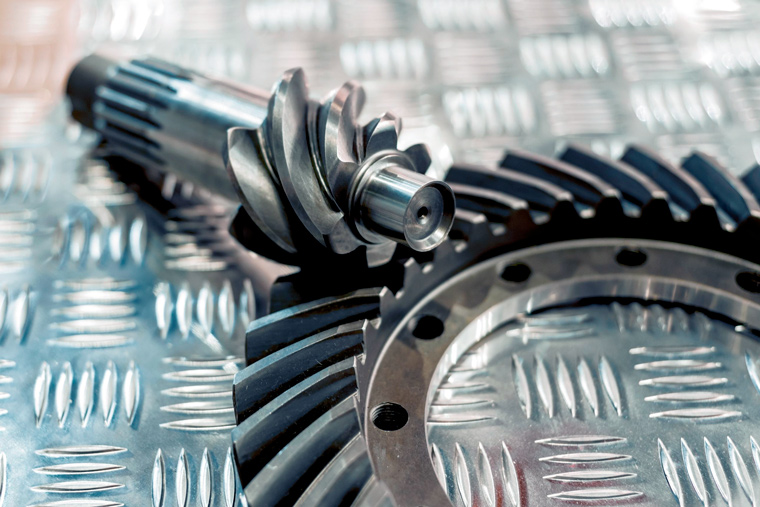
The term “helical” comes from “helix,” referring to something shaped like a helix or spiral, a structure that rotates around a fixed axis while moving along that same axis. This distinctive characteristic is what gives helical gears their unique properties and advantages compared to other transmission mechanisms.
The helical shape of the gear teeth facilitates smooth and continuous engagement between them. This shape minimizes sudden impacts and vibration during power transmission, resulting in quieter and more efficient operation.
Helical motion occurs when an object rotates around an axis while moving along that same axis, creating a helical trajectory. The distinctive characteristic of helical motion is the combination of rotation and translation, resulting in a spiral path, similar to that of a circular staircase.

Helical bevel gears have curved teeth in a helical shape, just like helical gears, but in a conical format. This allows them to transmit motion between intersecting shafts, usually at a 90-degree angle.
Helical gears are known for their ability to operate smoothly with minimal noise, even under heavy loads and at high rotational speeds. This is possible due to the helical shape of the teeth, which allows a more gradual and continuous engagement between gears. This type of gear is essential in systems where power transmission efficiency and vibration reduction are crucial.
Helical gears play a leading role in transmission mechanisms, offering technical solutions that meet the high-performance demands of various industrial sectors. They are used for:
The helical engine is a concept proposed by David Burns of NASA. The idea is that it would work based on the helical motion that particles would make inside an engine.
This motion could, theoretically, allow propulsion in space without fuel. It has not yet moved beyond the theoretical stage, but if viable, it could transform space exploration.
Helical gears and helical bevel gears are widely applied across various industrial sectors: